
Support Policy
Last Updated: October 13, 2026
Executive Summary
XCaliber Health, Inc. (“XCaliber”) provides a platform that automates integrations between electronic health records, claims systems, Health Information Exchanges, laboratories, and other healthcare data sources, and offers related features and functionalities, as well as other healthcare technology products and solutions (collectively, the “Platform”). This Support Policy and Service Level Agreement (“Support Policy”) sets forth the service levels and support commitments applicable to the Platform made available to an entity that has purchased a subscription to the Platform from XCaliber (“Customer”), as specified in a separate written agreement between XCaliber and Customer (“Agreement”). Capitalized terms not defined in this Support Policy have the meaning given to them in the Agreement.
Support
● Testing. As further described in the Documentation (as defined in the Agreement), XCaliber maintains processes designed to test and validate each release of the Platform before deployment, with the objective of identifying and minimizing bugs, defects, or errors that materially impair the operation of the Platform in accordance with the applicable specifications set forth in the Agreement (“Errors”).
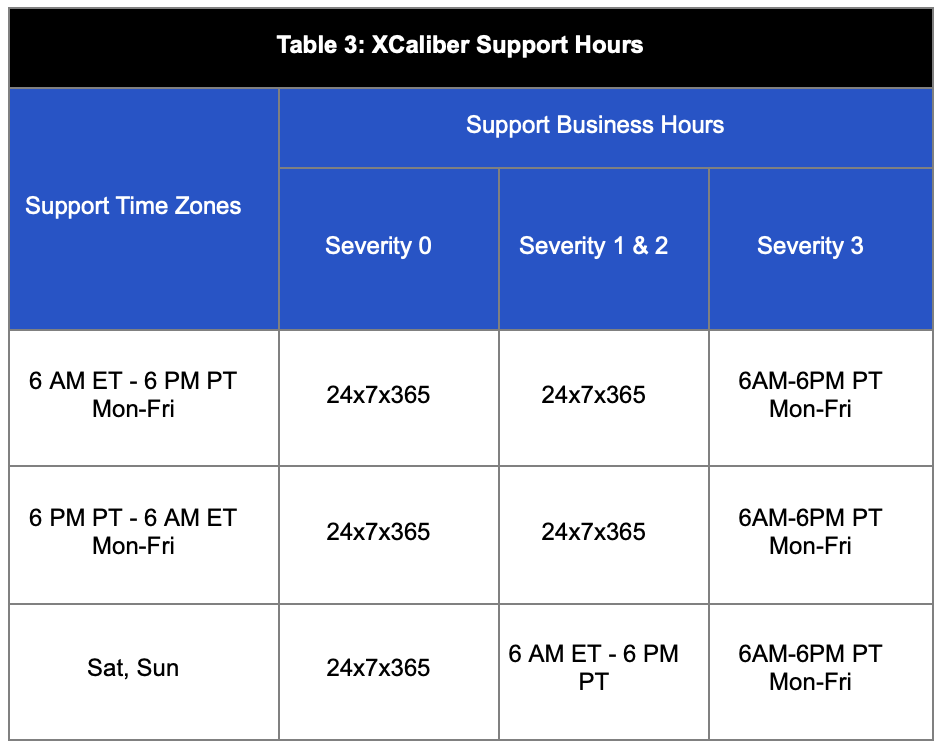
● General Support Offering. Customer shall designate at least one primary contact who will have administrator privileges and may designate additional contacts (“Customer Contact(s)”). XCaliber shall provide English-speaking remote assistance to Customer Contacts for questions or issues arising from any Error, as further described in this Support Policy, including troubleshooting, diagnosis, and recommendations for potential workarounds for the subscription term. XCaliber shall also provide the specific entitlements for the General Support Offering, as further described in this Support Policy and the tables below. XCaliber’s Support team (“XCaliber Support”) shall implement follow-the-sun case management for handling Severity Level 0 requests for help with Platform-related issues (each such request is a “Support Case”) to better facilitate uninterrupted support by utilizing XCaliber Support across multiple time zones. If Customer reasonably believes XCaliber Support is failing to provide timely and commercially reasonable responses in accordance with this Support Policy, Customer may escalate the Support Case using the support escalation process defined by XCaliber. Escalated Support Cases will be directed to XCaliber’s management team for consideration.
● Contacting XCaliber Health Support. Customer Contacts may contact XCaliber Support for assistance with Support Cases by the following methods: (1) Emailing support at support@XCaliber.health; (2) submitting a Support request in the Jira Service Desk web interface ; (3) submitting a Support request to the XCaliber through XCaliber-support slack workspace, (4) Customer Contacts may contact XCaliber Support by phone at the intake phone number identified below to submit the support request on their behalf. All Customer Contacts must be reasonably proficient in the use and functionality of the Platform and familiar with the Documentation and shall use reasonable diligence in performing their respective responsibilities under this Support Policy.
Communication Channels
○ Email: support@XCaliber.health
○ Jira Service Desk Ticket: There will be a customer-specific URL provided for ticket entry
○ Slack Channel support: Customer-specific slack channel. Access would be provided as part of the onboarding process
○ Telephone: 1-617-286-4122
● Submission of Support Cases. Each Support Case shall: (1) designate the Severity Level of the Error in accordance with the definitions in Table 1; (2) identify the account that experienced the error; (3) include information sufficiently detailed to allow XCaliber Support to effectively assess and troubleshoot the Error effectively, including any relevant error messages, logs, and steps to reproduce the Error, provided that Customer shall not include any PHI, personal data, sensitive data, other regulated data.); and (4) provide accurate contact information for the Customer Contact(s) most familiar with the Support Case. The Customer Contact(s) shall also give XCaliber any other important Support Case information in a timely manner. Information submitted pursuant to a Support Case is not Customer Data (as defined in the Agreement). The Support Case will have a default designation of Severity Level 2. If the Customer believes the issue to be related to Customer Application (as defined in the Agreement), then the Support Case shall also include the applicable Customer Application log files. If a Customer Contact submits a Support Case related to enhancement or new feature requests, XCaliber Health will deem the Support Case closed once the request has been forwarded internally.
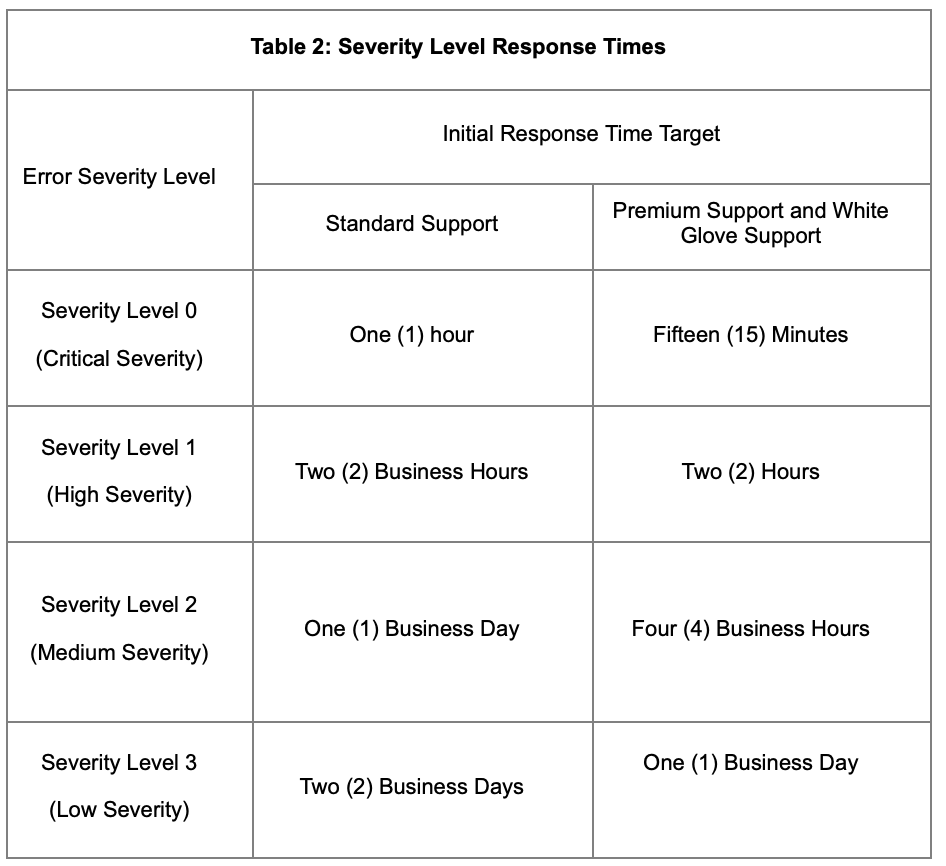
● Error Response. Upon receipt of a Support Case, XCaliber Support will assess the Error based on the information submitted and the definitions in Table 1, and if XCaliber believes Customer’s Severity Level designation is incorrect, XCaliber will promptly notify the Customer. If Customer then identifies a reasonable basis for disagreeing with the Severity Level proposed by XCaliber, the parties each will make a good faith effort to promptly discuss, escalate internally, and mutually agree on the appropriate Severity Level designation. XCaliber shall then use commercially reasonable efforts to meet the Initial Response Time Target set forth in Table 1 below for the applicable Severity Level, in accordance with XCaliber Support hours set forth in Table 3 below (“Support Hours”).


Service Level Agreement
Definitions:
“XCaliber Credit” is 1 credit and is one day’s fees attributable to the Platform worth of fees attributed to the Platform calculated by dividing the applicable monthly subscription fee by the number of calendar days in the relevant month.
“Calendar Minutes” is defined as the total number of minutes in a given calendar month.
“Error Rate” is defined as the number of Failed Operations, divided by the total number of Valid Operations. Repeated identical Failed Operations do not count towards the Error Rate.
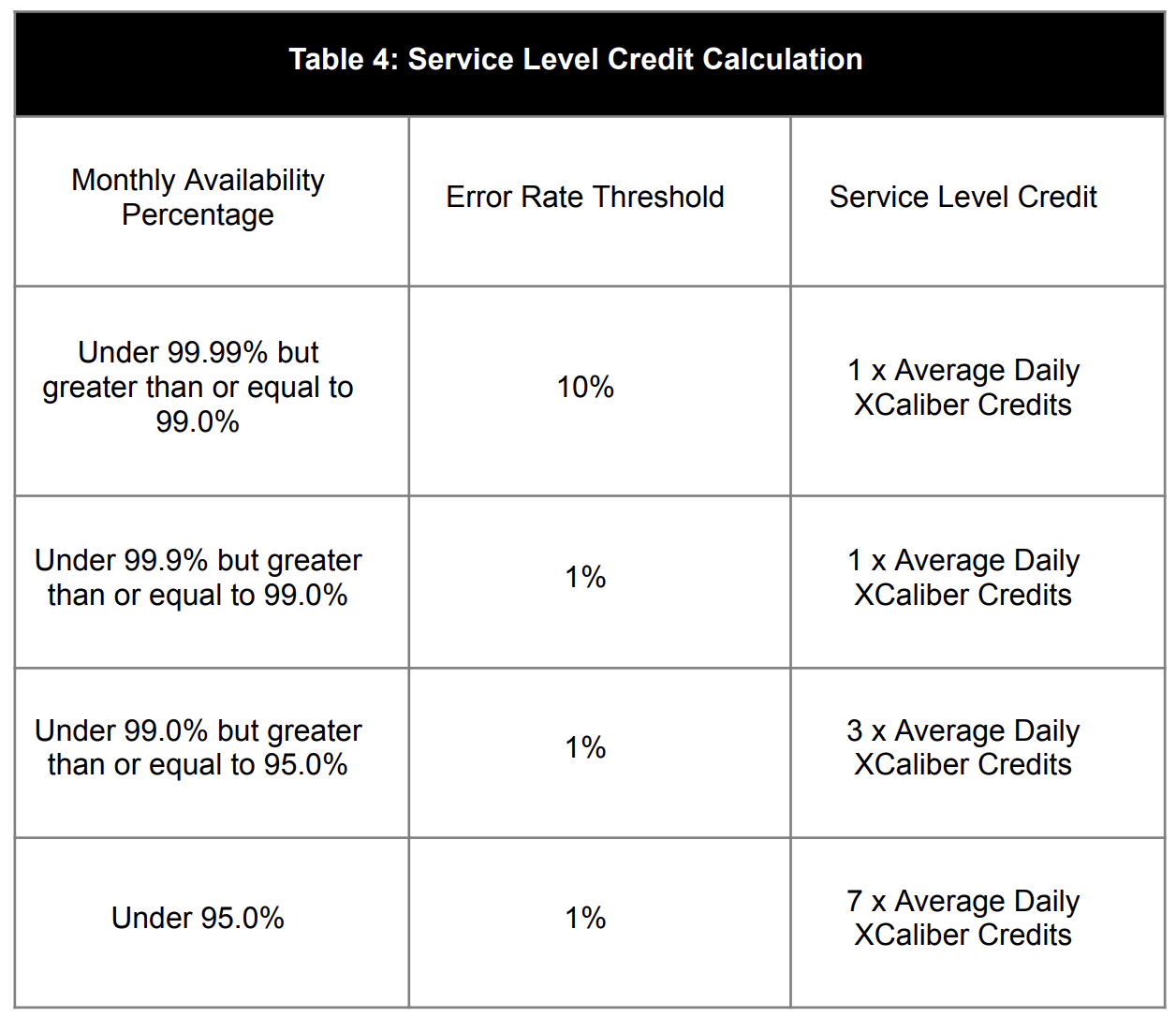
“Error Rate Threshold” is the value set forth in Table 4 below for each applicable Monthly Availability Percentage. This value represents the maximum Error Rate before a minute is considered Unavailable. For an example of Error Rate Threshold calculation, see Appendix A.
“Failed Operations” is defined as Valid Operations where the Platform encounters an internal error or delivers a response that is functionally incorrect, incomplete, or incongruous with the expected behavior as per the Documentation. This is subject to the SLA Exclusions below.
“Monthly Availability Percentage” is defined as the difference between Calendar Minutes and the Unavailable Minutes using the relevant Error Rate Threshold, divided by Calendar Minutes, and multiplied by one hundred (100).
“Service Level” is defined as a Monthly Availability Percentage of 99.99% when measured with a 10% Error Rate Threshold, and a Monthly Availability Percentage of 99.9% when measured with a 1% Error Rate Threshold.
“Service Level Failure” is defined as the Platform failing to meet the Service Level in a given month.
“Service Level Credits” is defined as the number of XCaliber Credits a Customer will receive in the event of a Service Level Failure for a given Monthly Availability Percentage and Error Rate Threshold, as indicated in Table 4. For an example of Service Level Credit calculation, see Appendix A.
“Unavailable” is defined as an Error Rate greater than the relevant Error Rate Threshold over a one-minute interval calculated across all accounts within each applicable cluster. The Error Rate is 0 when an account is inactive, i.e., when there are no Valid Operations in the one-minute interval.
“Unavailable Minutes” is defined as the total accumulated minutes when the Platform is Unavailable using the relevant Error Rate Threshold.
“Valid Operation” is defined as an operation that conforms to (a) the Documentation; or (b) Platform-use recommendations provided by XCaliber Support personnel. Platform-use recommendations can include but are not limited to:
● Adhering to the rate limits and usage quotas, if applies, to ensure optimal performance and prevent excessive resource consumption
● Following the recommended best practices for API request formatting
● Implementing appropriate error handling and retry mechanism in the Customer Application to gracefully handle transient failures and maintain data integrity
● Properly handling and reporting errors encountered during Platform usage to aid in troubleshooting and issue resolution by XCaliber Support
Table 4: Service Level Credit Calculation
SLA Exclusions
XCaliber will have no liability for any failure to meet the Service Levels hereunder to
the extent arising from:
● Customer’s failure to process Customer Data in the Platform in accordance with Documentation or XCaliber’s recommendations for use of the Platform — though, upon being notified of such a case, XCaliber will endeavor to help Customer address the failure (e.g., with additional recommendations)
● Customer Application or Customer or user equipment;
● Third-party acts, or services and/or systems not provided by or on behalf of XCaliber. For the avoidance of doubt, this exclusion (C) does not apply to the acts, services or systems of any cloud providers of XCaliber;
● Force Majeure events – i.e., any cause beyond such party’s reasonable control, including but not limited to acts of God, labor disputes or other industrial disturbances, systemic electrical, telecommunications, or other utility failures, earthquake, storms or other elements of nature, blockages, embargoes, riots, public health emergencies (including pandemics and epidemics), acts or orders of government, acts of terrorism, or war;
● Evaluation, free trial, or proof-of-concept use of the Platform; or
● Use of Platform features or functionality that are subject to Preview Terms (e.g., beta functionality not intended for production use).
Assumptions & Responsibilities
Assumptions
Assumptions related to in-scope features and/or components include:
● Regulatory, commercial, and any kind of material changes to Platform will be communicated and documented to all stakeholders.
Customer Responsibilities
Customer shall be responsible for ensuring that the following responsibilities and requirements are complied with in connection with its use of the Platform and any support provided under this Support Policy:
● Make a reasonable judgment on the severity of the issue getting reported based on the severity definition provided in the document
● Need to fully participate in reproducing, and troubleshooting the issues that get reported
● Provide all the necessary artifacts including data, privileged access to systems, logs etc. that can help facilitate the speedy resolution of the problem
● Every request needs to be logged as a ticket on Jira Service Desk in a workspace that the Customer would be provided access to as part of the onboarding process.
● Credentials will be shared with the Customer during onboarding using keybase and no secret keys or passwords will be shared in plain text formats in email or through a medium other than the prescribed one.
Appendix A
Example of Service Level Credit Calculation
First, let's assume the following:
● The Platform is down for an entire day (24 hours) in a 30-day month.
● The Customer is paying $6,000 per month for the service.
Step 1: Calculate the Average Daily XCaliber Credits
● Average Daily XCaliber Credits = Monthly Service Fee / Number of Days in the Month
● Average Daily XCaliber Credits = $6,000 / 30 = $200
Step 2: Determine the Monthly Availability Percentage and Error Rate Threshold
● In this case, since the Platform was down for an entire day, the Monthly Availability Percentage would be:
○ (Calendar Minutes - Unavailable Minutes) / Calendar Minutes * 100
○ ((30 * 24 * 60) - (24 * 60)) / (30 * 24 * 60) * 100 = 96.67%
● The Error Rate Threshold would be 1% since the Monthly Availability Percentage is
below 99.0%.
Step 3: Calculate the Service Level Credit
● Based on Table 4 in the Support Policy, for a Monthly Availability Percentage under 99.0% but greater than or equal to 95.0% with a 1% Error Rate Threshold, the Service Level Credit is 3 x Average Daily XCaliber Credits.
● Service Level Credit = 3 * $200 = $600
So, in this updated example, if the Platform is down for an entire day in a 30-day month, and Customer is paying $6,000 per month for the Platform, Customer would receive a Service Level Credit of $600.
Ticket Type Definitions and Handling
To ensure efficient handling and proper expectation setting, XCaliber defines the following categories for Support Cases. The appropriate handling and response will be based on both the ticket Type and the assigned Severity Level (where applicable).